
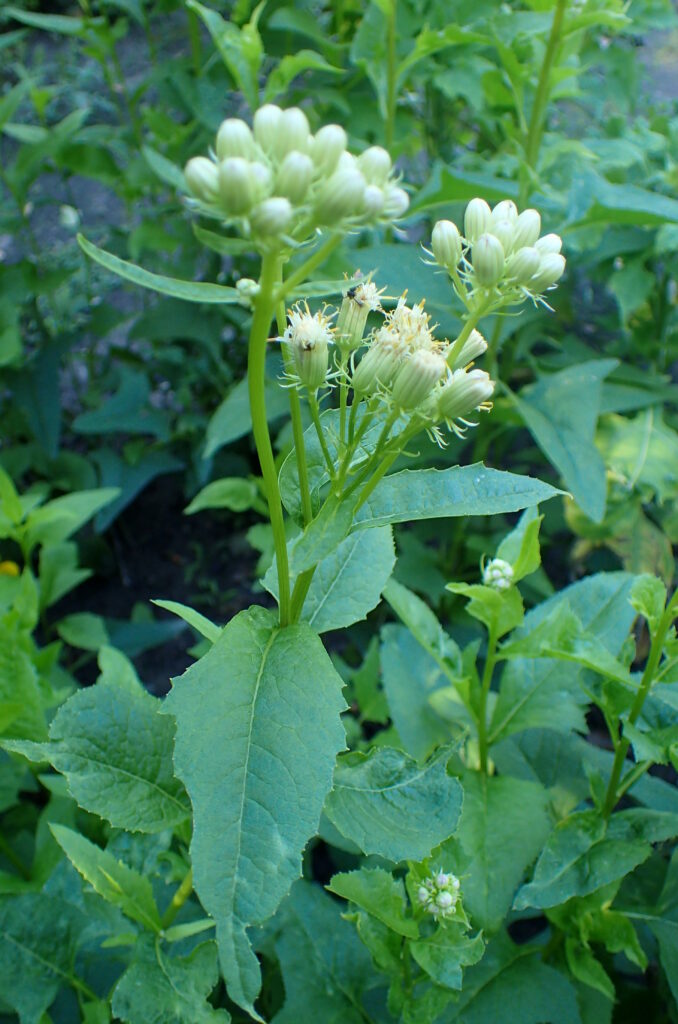
Hasteola suaveolens is an herbaceous perennial of the aster/composite family that typically grows to 3-5’ tall, but occasionally to 7’ tall or more. It is native to moist to wet soils along riverbanks, river floodplains, wet meadows along streams, marsh peripheries, and moist low woods from Connecticut to southeastern Minnesota south to Missouri, Tennessee, Maryland and in the mountains to Georgia. Plants have shallow, coarsely fibrous root systems.
Flowers in flat-topped clusters (corymbs) bloom from July to September. Flowers are creamy white but rarely pinkish. Each flowerhead has 25-30 creamy white to pinkish disk flowers (no rays). Seeds are distributed by the wind or sometimes by water.
Sweet Indian plantain is uncommonly found throughout much of its range in the U.S. Populations of this plant have declined to low levels in many areas of its native range because of habitat loss (wetland reduction). Draining and filling of wetlands has in many regions contributed to a significant decline of this species which is in large part dependent upon riverine habitats. It is currently listed as an endangered species in Connecticut, New York, Maryland and Minnesota. It is listed as a threatened species in several other States.
From the Native, Naturally!™ collection. It prefers any, moist to wet soil in part shade to full sun.
Image courtesy of Wikimedia