
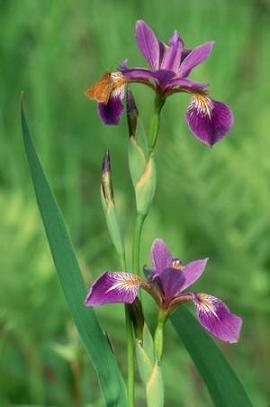
Iris versicolor commonly called larger blue flag iris or northern blue flag, is a clump-forming iris that is native to marshes, swamps, wet meadows, ditches and shorelines from Manitoba to Nova Scotia south to Virginia, Ohio, Illinois and Minnesota. It is a marginal aquatic plant that forms a clump of narrow, arching-to-erect, sword-shaped, blue-green leaves (to 24” long and 1” wide). Flowering stalks rise from the clump to 30” tall in late spring, with each stalk producing 3-5 bluish-purple flowers (to 4″ wide) with bold purple veining. Falls (sepals) have a central yellow blotch surrounded by a white zone. Clumps spread slowly by tough, creeping rhizomes. Larger blue flag thrives in wetland habitats frequented by rushes and sedges (the “flag” part of the common name comes from the middle English word flagge meaning rush or reed). Rhizome is poisonous. Genus named for the Greek goddess of the rainbow. Specific epithet means having various colors.
Iris versicolor has more robust stems and leaves that usually don’t extend above the flowers vs Iris virginiana. It also seems to tolerate drier conditions when established than Iris virginiana. The Potawatomi tribe used Iris versicolor leaves to weave mats and baskets.
From the Native, Naturally! Collection, it prefers rich, wet to moist soil in full sun.
Image courtesy of Ivy Garth Seeds